Whitby’s expansion east of Toronto has pushed development onto complex glacial terrain that demands thorough subsurface investigation. The town sits on a sequence of deposits left by the retreat of Lake Iroquois: dense silty clay tills overlying shale bedrock of the Georgian Bay Formation, with sand lenses and occasional organic fills near the former shoreline. A soil mechanics study becomes essential when footings intersect these transitional layers, where bearing capacity can swing dramatically across a single building footprint. The local planning department consistently requires geotechnical reports referencing the Ontario Building Code and CSA A23.3 for concrete design parameters. Our laboratory runs triaxial compression, Atterberg limits, and consolidation tests to characterize each stratum. For projects near the Lynde Creek valley or the protected wetlands along the waterfront, we pair the soil mechanics program with a slope stability assessment to address long-term erosion and setback requirements.
Whitby’s glacial stratigraphy can shift from competent till to soft lacustrine clay within a single borehole — sampling density matters.
Technical details of the service in Whitby
Procedure video
Typical technical challenges in Whitby
Part 4 of the Ontario Building Code, referencing NBCC 2015 with local amendments, mandates geotechnical investigation for all buildings exceeding 55 m² in area. In Whitby the critical risk is differential settlement where foundations straddle the contact between dense till and softer lacustrine clay — a scenario common in subdivisions carved into the former lakebed plain. A soil mechanics study that skips laboratory consolidation testing on the clay unit can underestimate long-term settlement by 30% or more, leading to costly underpinning or slab replacement five to ten years post-construction. For structures on shallow footings near the shale bedrock interface, we also evaluate sulfate exposure class per CSA A23.3 Table 3 to specify the correct cement type and cover thickness. The vibration-sensitive heritage district along Dundas Street adds another layer: any deep compaction or pile driving must be preceded by pre-condition surveys and vibration monitoring.
Our services
A complete soil mechanics study in Whitby includes field sampling, laboratory testing, and engineering analysis. The three core components delivered for every project:
Borehole Drilling and In-Situ Testing
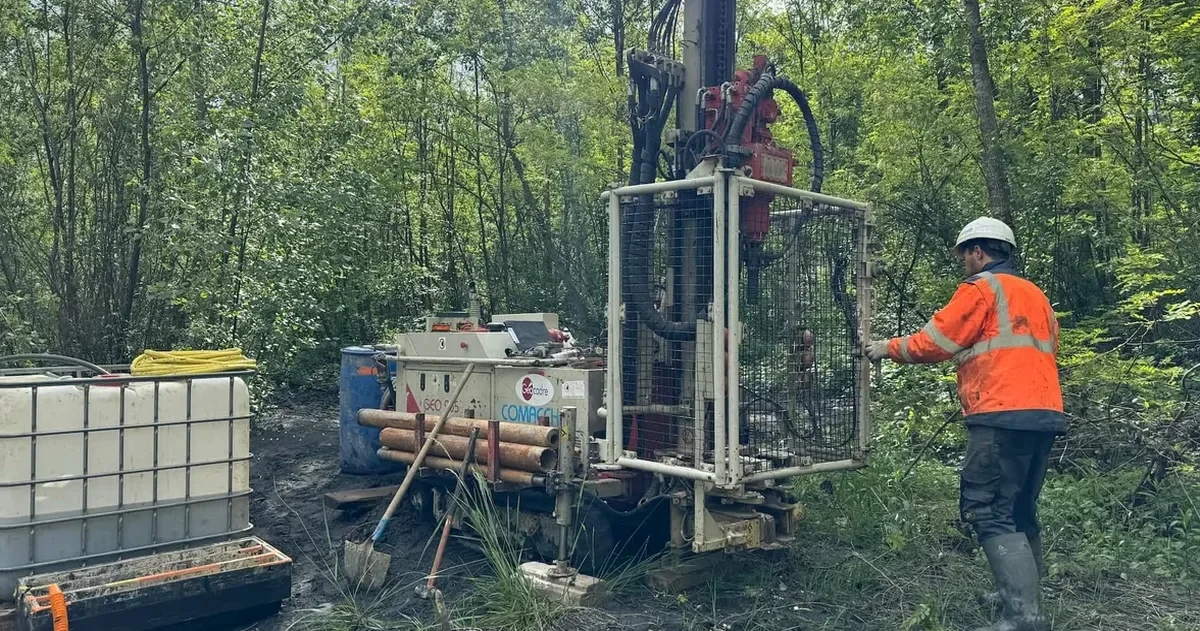
Hollow-stem auger borings to depths of 6–20 m with SPT sampling every 1.5 m. CPT soundings where dense till or cobbles require continuous profiling.
Advanced Laboratory Testing
Triaxial (CU and UU), one-dimensional consolidation, direct shear, Atterberg limits, grain size analysis, and sulfate testing on shale samples per CSA A23.3.
Foundation Design Parameters Report
Allowable bearing pressures, settlement estimates, frost protection depths, seismic site class per NBCC Table 4.1.8.4.A, and excavation recommendations.
Common questions
How deep are the boreholes for a typical Whitby residential soil mechanics study?
Most single-family home investigations require boreholes to 6–10 m depth, extending at least 3 m into competent till or 1.5 m into sound shale bedrock. For larger commercial buildings we typically advance borings to 15–20 m or to refusal.
What is the typical cost range for a soil mechanics study in Whitby?
The cost generally runs between CA$4,380 and CA$6,980 depending on the number of boreholes, laboratory tests required, and whether specialized testing like triaxial or consolidation is specified. A fixed quote is provided after reviewing the site plan.
How long does it take to receive the final geotechnical report?
Field work is typically completed in one to two days. Laboratory testing requires 10–15 business days for standard tests; consolidation and triaxial suites add roughly one week. The complete stamped report is usually delivered within three to four weeks of drilling.