A three-storey mixed-use building planned near Brock Street South ran into a problem we see all too often in Whitby: the borehole log showed 4.5 meters of soft, compressible silty clay overlying dense till, with groundwater at 2.1 meters. The structural engineer’s initial isolated footing design triggered differential settlement estimates above 40 mm—well past the 25 mm threshold the NBCC allows for this type of structure. The solution demanded a full raft foundation, and the analysis had to account for the Town of Whitby’s specific grading by-laws and the Ontario Building Code’s seismic provisions for the Durham Region. We modeled the soil-structure interaction using modulus of subgrade reaction values derived from in-situ plate load testing combined with consolidation parameters from laboratory oedometer tests on Shelby tube samples. The final 500 mm thick mat, stiffened with perimeter beams and an interior rib grid, brought predicted total settlement under 18 mm and angular distortion below 1/500. That project reflects the reality of raft and mat foundation design in Whitby: it’s rarely about the concrete and steel alone—it’s about reading what the glacial stratigraphy is telling you and translating that into a foundation system that works with the ground, not against it.
In Whitby's Iroquois Plain clays, a properly designed raft can cut differential settlement by 60-70% compared to interconnected isolated footings, simply by bridging soft pockets.
Technical details of the service in Whitby
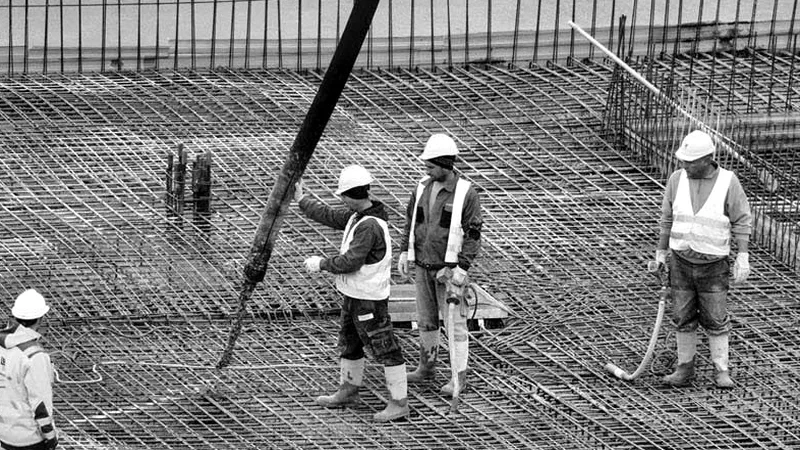
Typical technical challenges in Whitby
Compare a project on the dense till near Garden Street with one on the organic silts mapped along the Pringle Creek floodplain corridor, and you’re looking at foundation design problems that differ by an order of magnitude. The till site might give you an allowable bearing pressure of 200 kPa at a meter depth with settlement controlled almost entirely by elastic compression of the till itself—a stiff raft here works efficiently, and the main risk is encountering an unexpected boulder field that forces excavation deepening or localized blinding concrete adjustments. The creek-adjacent site is a different animal entirely: 6 to 9 meters of highly compressible, normally consolidated silts with organic lenses, an undrained shear strength that can dip below 25 kPa, and groundwater that fluctuates seasonally by over a meter. At that location, a raft foundation without ground improvement invites long-term consolidation settlement that can continue for years after construction. The real risk in Whitby isn’t a single soil type—it’s the abrupt transitions between these units over distances of less than 100 meters, a legacy of the glacial lake bottom and the retreating ice margin. A geotechnical investigation that misses these boundaries by spacing boreholes too widely will produce a raft design that’s either dangerously unconservative or wastefully overbuilt.
Our services
Our raft and mat foundation design work in Whitby spans the full project cycle, from feasibility-stage geotechnical characterization through to construction-phase subgrade inspection. We operate under a quality management system accredited to ISO/IEC 17025:2017 for laboratory testing, ensuring that every strength parameter, consolidation index, and soil classification feeding into the foundation model is traceable and defensible. The two core service modules described below cover the majority of raft foundation assignments we undertake in the Durham Region.
Geotechnical Investigation for Raft Design
Borehole drilling with SPT and Shelby tube sampling, laboratory determination of consolidation parameters (Cc, Cr, cv), undrained shear strength from triaxial UU and CIU tests, and groundwater monitoring standpipe installation. The resulting factual and interpretive report provides the allowable bearing pressure, modulus of subgrade reaction profile, anticipated total and differential settlement, and recommendations for any required subgrade preparation or ground improvement, all in compliance with NBCC Section 4.2 and Ontario Building Code requirements.
Structural Raft Analysis and Reinforcement Detailing
Finite element modeling of the raft slab as a plate on an elastic subgrade, using software that captures soil-structure interaction through spring supports calibrated to the site-specific subgrade modulus. The analysis checks punching shear at column locations, flexural demand under both service and factored load combinations, and temperature and shrinkage restraint. Deliverables include reinforcement layout drawings, bar schedules, and a design summary letter signed by a Professional Engineer licensed in Ontario, suitable for Whitby building permit submission.
Common questions
What does a raft/mat foundation design cost for a typical residential or small commercial project in Whitby?
For a standard residential or light commercial raft foundation in the Whitby area, the combined geotechnical investigation and structural design fee generally falls between CA$1,440 and CA$6,460, depending on the site's soil complexity, the number of boreholes required, and the building's footprint and column loads. A project on straightforward Halton Till with good access will be at the lower end; a creek-valley site with deep soft silts requiring consolidation analysis and possibly preloading recommendations will be at the upper end.
When does a raft foundation make more sense than strip footings or a pile foundation in Whitby?
A raft becomes the rational choice when the combined area of isolated or strip footings would cover more than about 50% of the building footprint, or when differential settlement between columns is projected to exceed the NBCC angular distortion limit of 1/500. In Whitby’s Iroquois Plain clays south of Dundas Street, we frequently find that strip footings sized for the low allowable bearing pressure end up so wide they nearly touch—at that point the raft isn’t just a technical solution, it’s the more economical one too, because it eliminates the formwork and backfill complexity of multiple closely spaced footings. The alternative—deep piles—is generally reserved for sites where the compressible layer extends beyond 12-15 meters, making a floating raft less efficient.
How do you account for frost heave in a Whitby raft foundation design?
The Ontario Building Code specifies a minimum frost penetration depth of 1.2 meters for the Whitby area. For a raft foundation, we address this by setting the underside of the mat at or below that depth, or by providing a rigid insulation skirt extending horizontally from the slab edge. In heated buildings, the thermal gradient from the interior typically keeps the subgrade temperature above freezing under the central portion of the raft, but the perimeter zone requires explicit frost protection detail. We specify extruded polystyrene (XPS) insulation with a minimum compressive strength of 210 kPa, sized to prevent frost lens formation in the underlying silt or clay.
What geotechnical parameters are critical for a raft foundation analysis in Whitby's soils?
The modulus of subgrade reaction (ks) is the single most influential parameter for the structural analysis, and it must be corrected for footing size and shape from the plate-load or triaxial-derived value. Equally important are the compression index (Cc) and recompression index (Cr) from oedometer tests on undisturbed samples—these drive the consolidation settlement calculation, which often governs the raft thickness and reinforcement in Whitby's softer clay zones. We also need the undrained shear strength profile to check bearing capacity under short-term loading, and the coefficient of consolidation (cv) to estimate time-rate of settlement, particularly when the client needs to know when they can start framing on the new slab.
How long does the design and approval process take for a raft foundation in Whitby?
From the initial site investigation to a permit-ready design package, a typical raft foundation project in Whitby takes between four and six weeks. The field investigation itself is usually two to three days of drilling and sampling, followed by two to three weeks for laboratory consolidation and triaxial testing. The analytical and drafting phase runs concurrently during the final week of lab work and typically requires an additional week. The Town of Whitby building department reviews the structural drawings and geotechnical report as part of the building permit application; their turnaround varies with workload, but a complete, code-compliant submission rarely triggers requests for additional information.