Whitby's transformation from a small lakefront settlement into a rapidly expanding Durham Region hub has placed new demands on its underlying geology. The town sits on the South Slope of the Oak Ridges Moraine, where surficial deposits of glacial till, glaciolacustrine silty clays, and the deep Queenston Shale formation create a layered subsurface profile. Every new subdivision, bridge approach, and mid-rise structure along the Highway 412 corridor requires precise shear strength data. The triaxial test provides the controlled stress-path modeling that direct shear cannot replicate, particularly for the saturated cohesive soils found across the Lynde Creek and Pringle Creek watersheds. Our laboratory team runs consolidated-undrained (CU) and consolidated-drained (CD) triaxial programs under ASTM D4767 protocols, delivering effective stress parameters (c' and φ') that Whitby's geotechnical consultants rely on for bearing capacity calculations and slope stability analyses in this post-glacial terrain.
Getting the effective stress friction angle wrong by just 2 degrees in Whitby's glacial till can alter bearing capacity estimates by over 15 percent.
Technical details of the service in Whitby
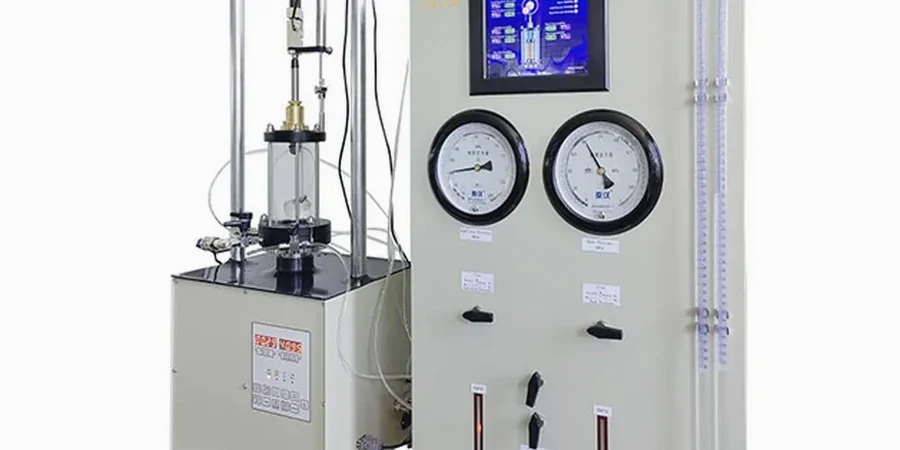
Typical technical challenges in Whitby
In Whitby, we frequently see projects where the undrained shear strength of the upper glaciolacustrine clay crust is overestimated during the preliminary desktop phase, only to be corrected downward once triaxial results come back. The risk manifests during wet spring conditions when the clay's sensitivity increases; a CU triaxial test with pore pressure measurement reveals the true contractive behavior that can trigger excessive settlement under footing loads. Skimping on triaxial testing and relying solely on index properties or pocket penetrometer readings leaves the design vulnerable to the anisotropic consolidation history of these layered deposits. Another local pitfall involves assuming drained conditions for the till without verifying through a CD triaxial test, given that the till's hydraulic conductivity varies by two orders of magnitude depending on the sand lens connectivity within the matrix.
Our services
Our Whitby triaxial laboratory runs three primary test configurations tailored to the specific drainage conditions and loading scenarios encountered across Durham Region projects. Each test type produces a distinct set of design parameters for use in limit equilibrium and finite element models.
Consolidated-Undrained (CU) Triaxial with Pore Pressure Measurement
The most requested configuration for Whitby's saturated silty clays. Specimens are isotropically consolidated under effective confining stresses matching the in-situ overburden, then sheared undrained while we record excess pore pressure via a high-precision transducer. Outputs effective stress cohesion (c') and friction angle (φ'), plus the undrained shear strength profile (c_u/σ'_v) needed for short-term stability checks during excavation.
Unconsolidated-Undrained (UU) Triaxial for Rapid Assessment
Applied to Shelby tube samples from the stiff Halton Till where immediate undrained strength is required for preliminary footing sizing. The test runs without consolidation or drainage, yielding total stress parameters (c_u, φ_u ≈ 0°) in under 48 hours. Suitable for emergency foundation verifications when construction sequencing cannot wait for full CU programs.
Common questions
What is the typical turnaround time for a triaxial test program in Whitby?
A standard CU triaxial test with three effective confining stresses takes 10 to 14 calendar days from specimen setup to final report. This includes back-pressure saturation (which may require 2-3 days for low-permeability lacustrine clays), consolidation for 24-48 hours per stage, and the controlled shear phase. UU triaxial tests can be completed in 2-3 days. We carry out interim pore pressure data upon request if your project deadline requires early-stage parameters for preliminary modeling.
Which triaxial test type is appropriate for the Halton Till in Whitby?
For long-term drained analysis of footings and retaining structures, a CD triaxial test (ASTM D7181) is appropriate if the till contains sufficient sand lenses to drain within the project timeline. For short-term excavation stability and immediate bearing capacity, the CU triaxial (ASTM D4767) is the standard choice because the till's silty clay matrix behaves undrained during the construction period. We recommend running both CU and CD suites if the till's drainage characteristics are uncertain.
How much does a triaxial test cost for a Whitby project?
A full CU triaxial program on three specimens falls in the range of CA$2,920 to CA$3,790, depending on specimen diameter, confining stress requirements, and whether you need additional index testing (Atterberg limits, grain size) on the same sample. UU triaxial suites are more economical. The final cost depends on the number of specimens and the testing standard required by your geotechnical engineer.
Can you test Queenston Shale bedrock samples in the triaxial cell?
Yes. We run triaxial compression on NQ or HQ rock core specimens extracted from the Queenston Shale formation. The procedure follows ASTM D7012 for intact rock, with confining pressures selected to bracket the in-situ horizontal stress at depth. We measure peak and residual strength envelopes, which are essential for designing deep foundations socketed into shale or assessing the stability of cuts along the Highway 401/412 interchange where shale weathering influences long-term slope behavior.
What sample quality do you require for triaxial testing?
We require undisturbed Shelby tube samples (75 mm or 100 mm diameter) with minimal disturbance during transport. Samples must be sealed with wax or end caps immediately after extrusion in the field and kept at in-situ moisture content. For the glaciolacustrine clays found in Whitby, sample disturbance from hammer-driven tubes can reduce undrained strength by 10-20%, so pushed or piston samples are strongly preferred. We visually log each specimen before trimming and reject any with visible fissures, gravel inclusions exceeding 1/6 of the diameter, or signs of desiccation. More info.