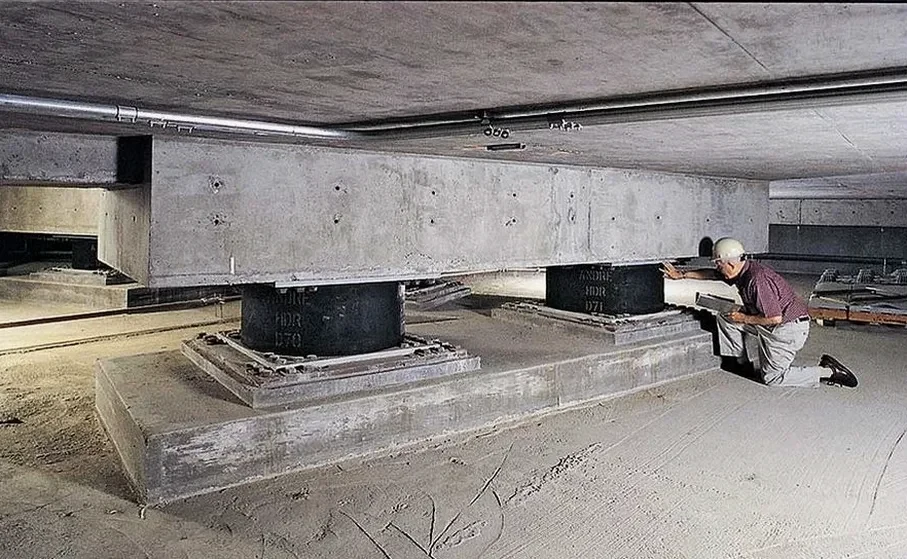
Whitby sits within a moderate seismic hazard zone under the National Building Code of Canada (NBCC 2020), but proximity to Lake Ontario introduces unique soil amplification effects that can intensify shaking during a distant seismic event. Many of the mid-rise institutional and commercial buildings constructed here in the last decade incorporate performance-based design requirements that go well beyond minimum life-safety criteria. Base isolation is not just a structural add-on in this region; it is a method to preserve operational continuity for critical facilities after an earthquake. In our expertise, the combination of glacial till overlying shale bedrock, common throughout Durham Region, creates an impedance contrast that affects how seismic waves propagate upward into a building. Proper base isolation seismic design requires a detailed understanding of these local stratigraphic conditions, which we evaluate through comprehensive site response analysis and geotechnical characterization before selecting isolation system parameters.
Decoupling a building from the ground in Whitby means designing for the 2,475-year return period while keeping the superstructure essentially elastic.
Technical details of the service in Whitby
Typical technical challenges in Whitby
A few years ago we reviewed a six-storey mixed-use project proposed north of Highway 401, where the initial design assumed Site Class C using a fixed-base concrete shear wall system. Our geophysical survey revealed a deeper pocket of soft clay that placed the site firmly in Site Class E according to NBCC Table 4.1.8.4.A. The design team faced two options: spend heavily on foundation strengthening and accept higher anticipated damage, or introduce base isolation to bring the seismic force demand down to a manageable level. The isolator solution added roughly three percent to the structural budget but eliminated the need for ductile core wall detailing and reduced the expected annualized loss by nearly half. That trade-off is typical in Whitby, where variable overburden thickness across the Iroquois Plain catches designers off guard. Skipping a site-specific hazard assessment before committing to a structural system creates a risk that no amount of over-strength factors can fully mitigate.
Our services
Our Whitby-based technical team provides a complete package of base isolation design and verification operations, from initial feasibility through construction support and long-term monitoring planning. Each service aligns with NBCC 2020 and CSA structural design standards.
Site-Specific Seismic Hazard Analysis
Deterministic and probabilistic seismic hazard assessment (PSHA) for the project coordinates, delivering uniform hazard spectra and time histories matched to the Whitby site condition for input into isolation system design.
Isolation System Design & Modeling
Selection and nonlinear modeling of elastomeric or friction pendulum isolators using ETABS and SAP2000, including stability checks, P-delta effects, and moat wall detailing for the maximum considered earthquake displacement.
Geotechnical Interface & Foundation Design
Integration of isolator load paths into the foundation system, including pedestal reinforcement, base slab punching shear checks, and confirmation of bearing capacity under seismic overturning loads per CSA A23.3.
Peer Review & Construction Phase Testing
Independent third-party review of isolation design calculations and prototype testing oversight, including full-scale bearing shear tests at 100% MCE displacement and aging property verification per manufacturer QA/QC protocols.
Common questions
What does a base isolation design package cost for a typical Whitby commercial building?
For a mid-rise commercial or institutional structure in Whitby, the complete isolation design package—including site-specific hazard analysis, nonlinear time-history modeling, and construction documentation—typically ranges from CA$5,250 to CA$11,430. The final cost depends on building footprint, number of isolators, and whether peer review is required by the approving authority.
How does NBCC 2020 treat base isolation compared to previous code editions?
NBCC 2020 references CSA S832 for seismic isolation design and provides explicit provisions in Clause 4.1.8.16 for structures with seismic isolation systems. The code requires nonlinear response history analysis for all isolated structures, with a minimum of 11 ground motion pairs scaled to the site-specific hazard. This represents a significant advancement over the 2015 edition, which offered limited guidance and pushed many designers toward ASCE 7 for methodology.
What site investigation is required before designing a base isolation system in Whitby?
We require a shear wave velocity profile to at least 30 meters depth (Vs30) for NBCC site classification, plus deeper bedrock mapping where shale is suspected within 50 meters of foundation level. A site-specific response analysis is mandatory under NBCC 2020 for Site Class D and E, which are common in Whitby. We also recommend a liquefaction assessment given the lacustrine deposits near the Lake Ontario shoreline.
Can base isolation be retrofitted to an existing building in Whitby?
Yes, though it is more complex than new construction. The technique involves temporarily supporting the structure on jacking piles, cutting columns at the isolation plane, and inserting isolators. We have performed this on heritage masonry buildings in southern Ontario where preservation requirements preclude major lateral strengthening. The feasibility depends on column spacing, existing foundation capacity, and the available headroom in the crawl space or basement. More info.