Whitby’s geology splits in two directions once you get past the 401. North of Taunton Road you’re into the Oak Ridges Moraine—till, sand, some gravel, decent bearing. But down toward the lake, from Port Whitby to Lynde Shores, it’s a different story: thick deposits of glaciolacustrine clay and silt that go soft the moment moisture content climbs above the plastic limit. We’ve seen projects where the difference between a straightforward spread footing and a full ground improvement scheme came down to 300 meters of lateral variation in the same subdivision. That’s where stone column design becomes the rational choice—not as a fallback, but as the first option when the soil profile tells you settlement will be the controlling factor. For projects near the waterfront where liquefaction potential needs to be addressed, combining stone columns with a liquefaction assessment gives the full picture before a single rig mobilizes.
A well-designed stone column grid in Whitby’s lacustrine clays typically achieves a settlement reduction factor between 2 and 4, verified by post-installation modulus tests.
Technical details of the service in Whitby
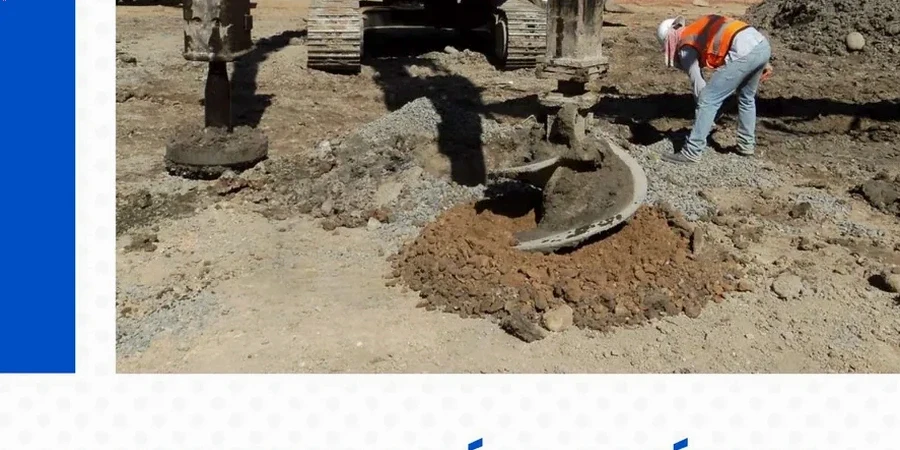
Typical technical challenges in Whitby
Whitby sits at roughly 105 meters above sea level near the lake, but the real number that matters for foundation engineers is the depth to the bedrock—often exceeding 30 meters in the southern half of town. When you’re thirty meters above the Georgian Bay Formation shale and the upper fifteen meters are soft to firm silty clay, the risk isn’t bearing capacity failure; it’s long-term consolidation settlement that can rack a structure over five to ten years. A poorly designed stone column installation in these conditions—too shallow, wrong aggregate gradation, insufficient lateral confinement—can actually accelerate settlement by creating drainage paths that speed up primary consolidation without providing the vertical stiffness needed. The NBCC 2020 requires serviceability limit state checks that explicitly account for time-dependent settlement. If the column length doesn’t penetrate through the compressible layer into stiffer till, you’ve built an expensive drainage system, not a ground improvement solution. We’ve also got to watch for vibro-installation effects on adjacent buried utilities, especially the older cast iron watermains still present in downtown Whitby.
Our services
Stone column design doesn’t exist in isolation. The ground model has to be solid before the first column is laid out, and verification testing confirms whether the design assumptions hold. Our Whitby workflow ties three phases together:
Pre-Design Site Characterization
Laboratory testing program including Atterberg limits, grain size distribution, and CU triaxial tests on undisturbed Shelby tube samples from the target depth. We map the undrained shear strength profile to define the column bearing layer.
Column Design and Grid Optimization
Analytical design using the Priebe method with FE verification in Plaxis 2D. We optimize the area replacement ratio to meet total and differential settlement limits, delivering a complete installation plan with column diameter, spacing, and depth.
Post-Installation Verification
Modulus verification through plate load tests on single columns and composite ground. We compare back-calculated stiffness with design assumptions and adjust the grid if necessary before structural construction begins.
Common questions
What’s the typical cost range for stone column design in Whitby?
For a standard residential or light commercial lot in Whitby, stone column design fees typically range from CA$1,990 to CA$7,580 depending on the footprint, number of columns, and complexity of the soil profile. Larger industrial projects with multiple loading zones and FE modeling will fall at the upper end or beyond. Every quote includes the pre-design lab testing program and the installation specification package.
How do you confirm the columns are working after installation?
We specify plate load tests on at least 2–5% of the installed columns, depending on site variability. A reaction frame loads the column head in increments while we measure settlement with dial gauges referenced to an independent beam. The load-settlement curve gives us the modulus of the column and the composite ground, which we compare directly against the design assumptions. In sensitive clays, we also run CPT soundings between columns to check for installation disturbance.
Can stone columns be used below the water table in Whitby’s lakeshore areas?
Yes, and they often are. The bottom-feed vibrator method places stone through the tip of the probe, which keeps the column intact even in fully submerged conditions. The key is maintaining a positive head of stone in the feed pipe so water doesn’t wash fines into the column. In Whitby’s near-lake zones where groundwater is within 1–2 meters of grade, we design for submerged unit weights and check for hydraulic connectivity that could accelerate consolidation of the matrix soil.
How long does the design phase take?
From receipt of the geotechnical investigation data to delivery of the signed design package, count on two to three weeks for a typical Whitby project. That includes the laboratory testing window—consolidation and triaxial tests need time to run—plus the analytical and FE modeling iterations. Rush schedules are possible if the lab prioritizes the samples, but consolidation tests can’t be accelerated without compromising the data.