In Whitby, you can't drive piles ten metres without hitting something surprising. The ground shifts from stiff Halton Till to Georgian Bay shale faster than most engineers expect, and we've seen that catch out-of-town consultants more times than we can count. Our team works from the premise that every deep dig here tells a story about the Lake Ontario ice lobe that shaped this landscape. We combine borehole data, lab strength testing, and a working knowledge of local hydrogeology to design excavation support systems that actually hold up during spring thaw. When the till is dense and the water table is behaving, a straightforward soldier pile and lagging wall does the job. When you're cutting into weathered shale near the Lynde Creek valley, the slope stability analysis becomes the critical path item before you even think about shoring. We don't design from a textbook. We design from what we've measured in the ground across Whitby's subdivisions, from Brooklin to Port Whitby.
Whitby's overconsolidated till is a gift for excavation stability — until a sand lens turns your dry cut into a pumping operation.
Technical details of the service in Whitby
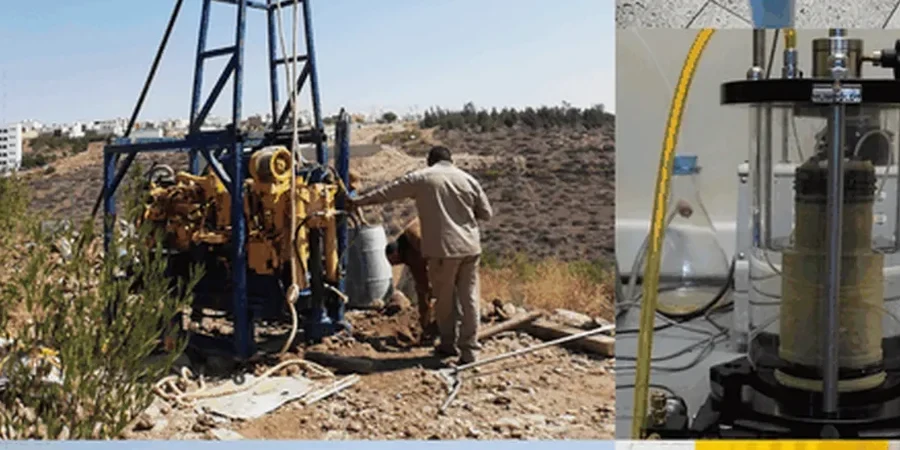
Typical technical challenges in Whitby
A few years back, a crew on Dundas Street hit a pressurized sand pocket at 6 metres depth, right beneath a stiff till cap. The bottom of the excavation started boiling within twenty minutes, and the neighboring gas station forecourt settled 40 millimetres before they got pumps in. That scenario replays across Whitby because the till-bedrock interface is rarely a clean contact — eroded channels filled with water-bearing sand and gravel hide in the palaeotopography. The big risk in deep excavations here isn't just wall collapse; it's hydraulic blowout and progressive loss of passive resistance. If you skip the pre-excavation piezometer array, you're guessing, and guessing in downtown Whitby with old brick buildings on shallow footings is not a strategy. Basal heave in the shale is another one: the rock looks solid on the core box, but the upper three metres can be so jointed and softened that it behaves more like a blocky soil. We spec underdrainage and carefully staged bench cuts to keep pore pressures low and exposed faces stable.
Our services
Our excavation design work in Whitby covers everything from pre-dig investigation through to construction-phase verification. Each package is tailored to the ground conditions we actually find, not a generic report template.
Shoring and Bracing Design
Steel soldier piles with timber lagging, secant pile walls for water cutoff, or tied-back systems — selected based on your cut depth and proximity to Whitby's property lines.
Dewatering and Groundwater Control Plans
Deep well, wellpoint, or eductor systems designed from in-situ permeability testing. We size pumps for spring conditions, not just the dry August reading.
Instrumentation and Monitoring Specifications
Inclinometer, piezometer, and settlement point layouts tied to threshold values. We define trigger levels so your site team knows when to stop and reassess.
Common questions
What's the typical cost range for a deep excavation design in Whitby?
For a typical commercial or multi-residential excavation in Whitby, geotechnical design fees generally fall between CA$2,580 and CA$11,720, depending on the depth, shoring complexity, and whether groundwater control measures are needed. A straightforward 4-metre cut in dry till sits at the lower end, while a 10-metre tied-back wall with dewatering and monitoring specs moves toward the upper end.
How deep can we excavate before we need shoring in Whitby?
Ontario Regulation 213/07 requires protective measures for any excavation deeper than 1.2 metres where workers may enter, but geotechnically, Whitby's stiff Halton Till can often stand vertically to 3 or 4 metres for short periods in dry conditions. We never recommend unshored cuts beyond that — especially near roads or buildings — because the till contains vertical joints that can open without warning after rain or freeze-thaw cycles.
Do you design for blasting in shale bedrock?
Yes. When the excavation extends more than a metre or two into the Georgian Bay Shale, mechanical ripping with a large excavator is usually the first choice. If the rock is too competent or the site is too confined for ripping, we coordinate with a blasting consultant to design controlled blasting patterns that limit vibration and overbreak, with pre-blast surveys for nearby structures.
What information do you need from us before starting the design?
We'll need your architectural and structural floor plans, a site survey with property boundaries and existing utilities, and any previous geotechnical reports for the parcel. If no borehole data exists, we'll scope a subsurface investigation first — usually a combination of boreholes in the excavation footprint and test pits for utility clearance — because designing without local stratigraphy is not something we'll stamp.