The soil profile across Whitby—particularly south of Highway 401 toward the Lake Ontario shoreline—reflects a complex legacy of glaciolacustrine clays and silty tills deposited by glacial Lake Iroquois roughly 12,000 years ago. These fine-grained deposits often contain interbedded varves with moisture contents that fluctuate dramatically between wet spring months and dry summer conditions. When we sample a silty clay from a foundation depth of 2 to 5 metres, the liquid limit can easily range from 35% to 55% depending on organic content and clay mineralogy. That number alone dictates whether the material will behave as a stiff, workable subgrade or a highly compressible stratum requiring preloading or removal. Without an Atterberg limits determination—liquid limit, plastic limit, and the derived plasticity index—any foundation recommendation for Whitby’s sensitive clays remains an educated guess rather than an engineered decision.
Atterberg limits are not just index numbers—they are the first line of defense against misclassifying a sensitive Whitby clay as a stable bearing stratum.
Technical details of the service in Whitby
Procedure video
Typical technical challenges in Whitby
The Ontario Building Code (OBC) and CSA A23.3 require that foundation bearing capacity and serviceability assessments for fine-grained soils incorporate the plasticity characteristics of the bearing stratum—not merely undrained shear strength from a pocket penetrometer or vane. In Whitby, the risk is amplified by the presence of glaciolacustrine clays that have been preconsolidated by glacial loading but are now undergoing gradual rebound and softening near the surface. A soil with a plasticity index above 30% and a liquidity index approaching 0.8 can lose nearly half its undrained shear strength upon remolding or wetting—a scenario that plays out in open excavations after heavy rainfall. We have observed localized slope failures in temporary cut faces along the Duffins Creek and Lynde Creek corridors where the design assumed a stiff clay based on SPT N-values alone, while the Atterberg limits later revealed a high-plasticity, sensitive fabric susceptible to progressive creep. Overlooking the plasticity index when specifying footings or shallow mat foundations in these deposits introduces a settlement risk that manifests not during construction, but two to five years post-occupancy.
Our services
Our Whitby laboratory provides Atterberg limits testing as both a standalone classification service and as part of integrated geotechnical investigation packages. We process samples within 48 hours of extraction because moisture loss during storage shifts the liquid limit—a detail that matters when the clay fraction exceeds 30%.
Multipoint Liquid & Plastic Limit Determination
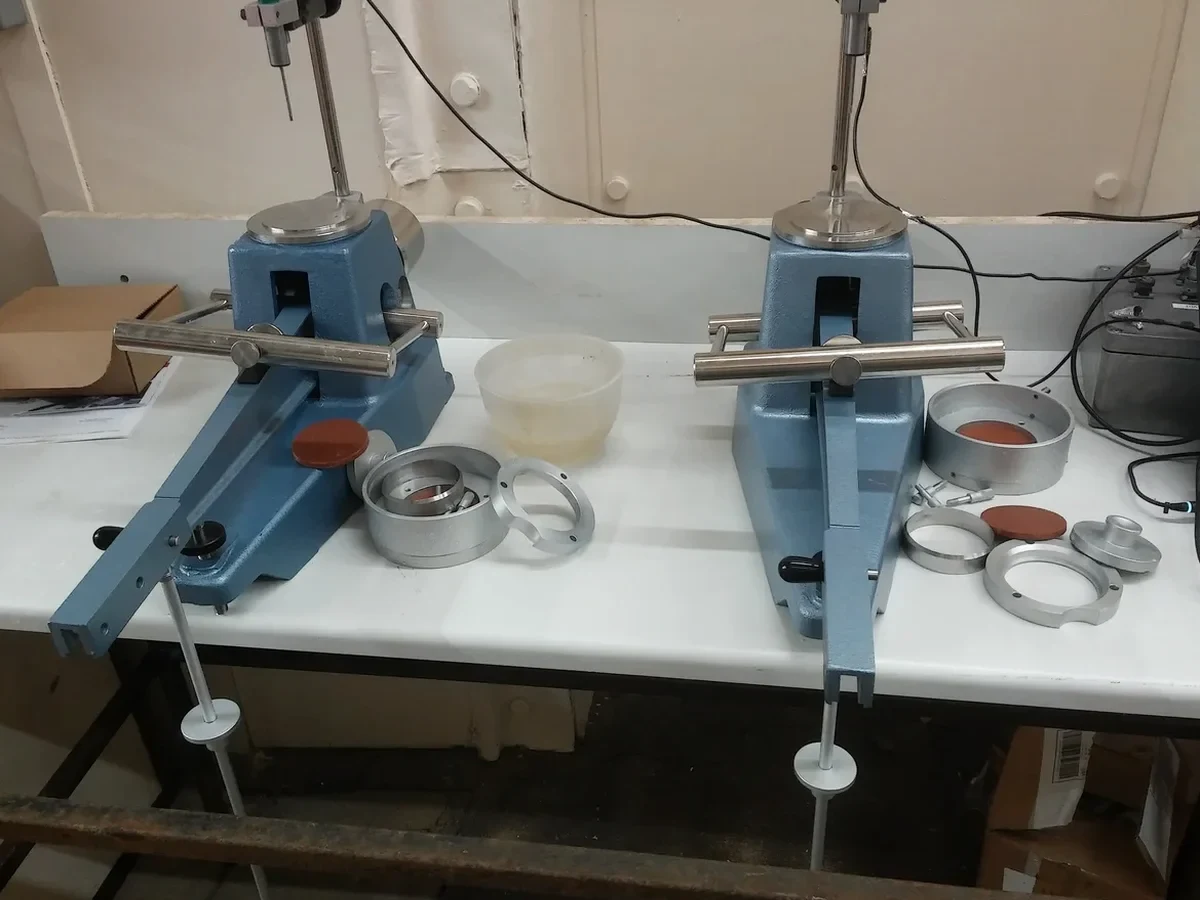
Full Casagrande cup procedure with 4-5 data points for the flow curve, plus hand-rolled plastic limit threads. We report LL, PL, PI, and the USCS classification symbol with the Casagrande plasticity chart position. Suitable for subdivision earthworks, stormwater pond liners, and foundation subgrade verification across Whitby's glaciolacustrine terrain.
Atterberg Limits with Complementary Grain-Size and Moisture Content
Combined package that adds full hydrometer and sieve analysis to the Atterberg limits, enabling calculation of Activity (A) and Liquidity Index (LI). Recommended when the project requires a defensible classification for Ontario Building Code submissions or when the soil exhibits borderline plasticity between CL and CH.
Common questions
How much does Atterberg limits testing cost for a project in Whitby?
A standard multipoint liquid limit and plastic limit determination on a single sample typically falls in the range of CA$100 to CA$140. The total cost depends on the number of samples, whether complementary grain-size analysis or moisture content is included, and the required turnaround time. We carry out a lump-sum quote after reviewing the borehole log and sampling plan.
What is the difference between the one-point and multipoint liquid limit test, and which one do you use?
The one-point method estimates the liquid limit from a single blow count using a pre-established slope assumption, which introduces error when the soil's flow curve deviates from the typical range. We run the full multipoint procedure (ASTM D4318 Method A) because Whitby's glaciolacustrine clays and silts often produce non-standard flow curves that require 4 to 5 data points for an accurate determination. The multipoint method is the only approach accepted for Ontario Building Code compliance in our expertise.
How long does it take to receive Atterberg limits results after sampling?
Standard turnaround is 3 to 4 business days from sample reception, provided the samples arrive in sealed, moisture-retaining containers. We can expedite to 24-48 hours for active construction projects where excavation stability or compaction acceptance depends on the plasticity data. The drying and re-mixing stages cannot be bypassed, so truly same-day results are not technically feasible for the multipoint procedure.