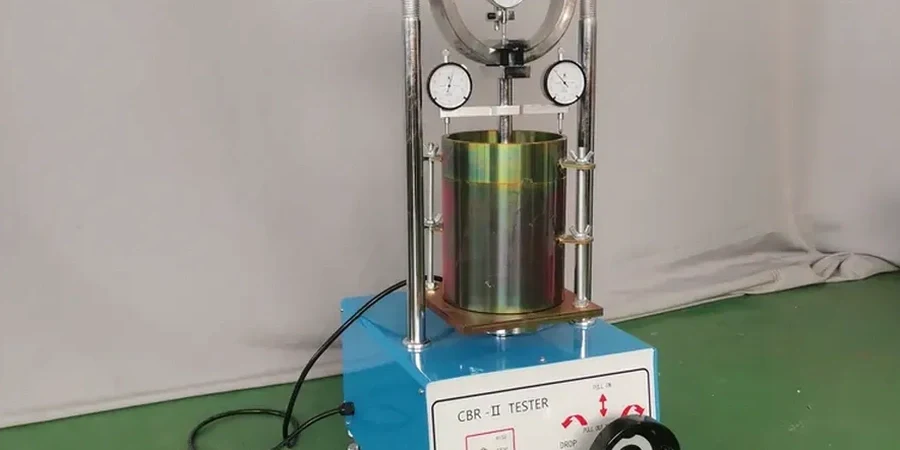
ASTM D1883 governs the laboratory California Bearing Ratio test. In Whitby, where glacial till and Lake Iroquois plain deposits dominate the subsurface, this standard is not optional. It is the backbone of pavement thickness design. The Municipality of Whitby and the Region of Durham both enforce strict subgrade strength verification under the Ontario Provincial Standards (OPS). Without a reliable CBR value, granular base and asphalt thickness calculations are guesses. Our lab processes both soaked and unsoaked specimens. We simulate the worst-case saturation scenarios typical of spring thaw in the 43.88° N latitude. The data feeds directly into AASHTO 1993 and M-E pavement design methods. For projects along Thickson Road or Baldwin Street corridors, we often pair the CBR with a field grain-size analysis to confirm fines content before compaction.
A single soaked CBR value at 95% compaction can change the required asphalt thickness by up to 40 mm. In Ontario's freeze-thaw climate, that margin is everything.
Technical details of the service in Whitby
Typical technical challenges in Whitby
A common mistake in Whitby subdivisions is testing only unsoaked CBR. The native Halton Till looks strong when dry. A contractor sees a value of 20% and assumes a thin pavement structure will suffice. Then the spring melt comes. Water ponds in the granular subbase. The till saturates. The soaked CBR drops below 3%. The pavement fails within two seasons. Another error is ignoring swell potential. We have measured over 5% swell in silty fine sands from the Lake Iroquois plain. That uplift cracks the asphalt from below. The lab report must include both swell and corrected CBR. The Ontario Traffic Manual (OTM) Book 2 references these thresholds. Ignoring them is a liability. The cost of a proper soaked CBR test is negligible compared to a premature reconstruction.
Our services
Our laboratory in the Greater Toronto Area supports Whitby projects with three tiers of CBR testing, aligned with Ontario's pavement design workflow.
Subgrade CBR Evaluation
Remolded specimens at target moisture and density per MTO compaction specifications. Soaked and unsoaked values reported with swell data.
Granular Base CBR
Testing of Granular A and Granular B materials per OPSS 1010. We verify that the aggregate meets the 100% CBR minimum for base course.
CBR vs. Moisture Relationship
A three-point or five-point curve showing CBR sensitivity to molding moisture. Critical for Whitby sites with variable drainage.
Common questions
What is the difference between field CBR and lab CBR in Ontario?
Field CBR uses a dynamic cone penetrometer or in-situ CBR device directly on the subgrade. Lab CBR per ASTM D1883 uses a remolded sample compacted at a controlled moisture and density. The lab test allows a 96-hour soak to simulate worst-case saturation. MTO typically requires lab CBR for design and field CBR for quality assurance during construction.
How much does a laboratory CBR test cost in Whitby?
A single-point soaked CBR test typically costs between CA$150 and CA$320, depending on whether it includes the Proctor compaction curve and swell measurement. A full CBR-moisture relationship curve with three points will be at the higher end of that range.
How many CBR samples do I need for a subdivision road design?
For a typical Whitby subdivision, one CBR test per distinct soil unit is the minimum. If the borehole logs show both Halton Till and Lake Iroquois sand, you need at least two CBR tests. The Town of Whitby engineering standards may require one test per 500 meters of roadway for preliminary design.
What CBR value is considered acceptable for residential streets?
Ontario Provincial Standards generally require a design CBR of 3% or higher for local residential streets. Below 3%, subgrade treatment such as over-excavation, geotextile separation, or lime stabilization may be required. A CBR of 6% is often targeted for collector roads with higher traffic loads.