Whitby’s expansion from a lakeside port community into a Durham Region growth hub brought development onto increasingly complex glacial deposits. The Oak Ridges Moraine and glacial Lake Iroquois shoreline left a patchwork of sands, silts, and stony tills across the municipality. A grain size analysis (sieve + hydrometer) maps this distribution from cobble-sized particles down to the sub-2-micron clay fraction. It is not a routine index test here — it is the first diagnostic step before assigning permeability, frost susceptibility, or compaction targets to a specific Whitby formation. Without a complete hydrometer curve, a till that “feels sandy” at the rig can still carry 18 percent clay and fail drainage assumptions. Ontario Building Code references and the Ministry of Transportation’s LS-702 protocol both require the full combined method when fines content exceeds 12 percent. Our laboratory runs the hydrometer sedimentation phase under strict ASTM D7928 temperature control, reporting percent gravel, sand, silt, and clay with the uniformity coefficient and coefficient of curvature that every Whitby pavement and foundation design needs.
A washed No. 200 sieve split tells you how much fines exist; the hydrometer tells you whether those fines will drain, heave, or hold pore pressure through a Whitby spring thaw.
Technical details of the service in Whitby
Typical technical challenges in Whitby
The south Whitby lowlands, particularly near the Lynde Creek and Pringle Creek floodplains, sit on glaciolacustrine silts with a perched water table that rises to within 1.2 m of grade during March snowmelt. A grain size analysis that stops at sieve No. 200 misses the critical 0.02 mm to 0.002 mm silt band that governs capillary rise and frost heave in these saturated profiles. When a contractor places a standard granular base over an uncorrected silt subgrade identified only as “15 percent passing No. 200,” the spring breakup cycle can pump those fines into the granular voids within three freeze-thaw seasons. The resulting loss of structural support shows up as longitudinal cracking along collector roads and differential settlement at shallow-footing residential slabs. We have measured post-construction gradation shifts of 6 to 9 percent in the minus-75-µm fraction on Whitby sites where no pre-design hydrometer curve was obtained. The combined sieve-and-hydrometer method gives the drainage and frost-design parameters — specifically the D15-filter compatibility and the segregation potential — that NBCC Part 9 and CSA A23.3 implicitly require when foundation soils contain more than 10 percent fines. Skipping the hydrometer is a risk that costs far more to remediate than to measure.
Our services
Our Whitby grain size program covers the full spectrum from field sampling through final USCS classification, with every phase calibrated to Durham Region’s glacial stratigraphy.
Combined Sieve-and-Hydrometer Package
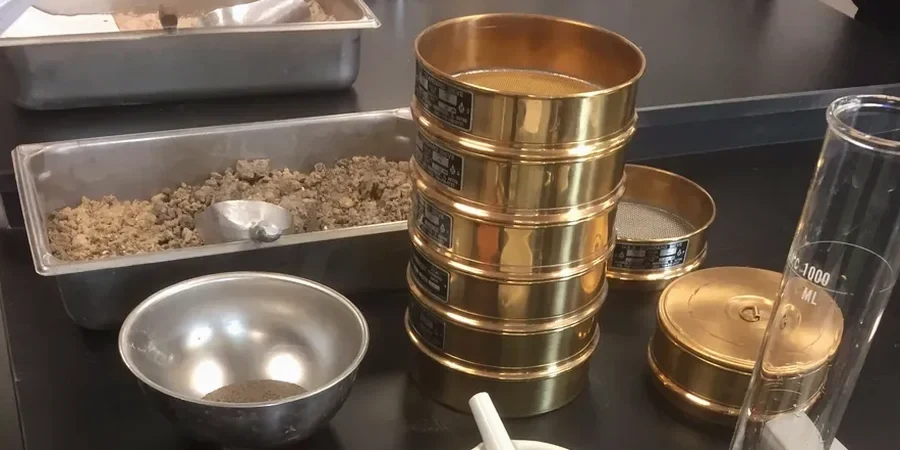
Complete ASTM D6913/D7928 sequential analysis on one split sample. We oven-dry, wash, and mechanically sieve the coarse fraction before transferring the minus-75-µm material to a controlled-temperature sedimentation bath. The hydrometer readings follow the standard 0.5, 1, 2, 4, 8, 15, 30, 60, 120, 240, and 1 440-minute schedule, corrected for meniscus, temperature, and dispersant blank. You receive a dual-axis gradation plot, the USCS group symbol, AASHTO classification, and a tabulated summary of all D-values, Cu, and Cc.
Subgrade Frost-Susceptibility Screening
Targeted hydrometer-only analysis on the fine fraction of Whitby road subgrades, with emphasis on the 0.02 mm threshold that separates frost-susceptible silts from non-susceptible coarser fractions. We calculate the segregation potential from the percent finer than 0.02 mm and correlate it with the local frost penetration depth published by the Ontario Building Code for Zone 2 (1.2 m). The report includes a clear yes/no frost-susceptibility statement per CSA A23.3 criteria.
Common questions
What does a combined grain size analysis cost for a Whitby soil sample?
For a single sample requiring both mechanical sieving (ASTM D6913) and hydrometer sedimentation (ASTM D7928), fees generally range from CA$120 to CA$280 depending on the percentage of fines and whether the sample contains oversized cobbles that require extra splitting. A standard Halton Till sample with moderate fines falls near the middle of that range. Rush turnaround or weekend processing adds a surcharge.
How long does the hydrometer phase take after the sieve portion is complete?
The sedimentation phase runs a minimum of 24 hours from the moment the cylinder is agitated, with readings logged at precise intervals up to 1 440 minutes. Including oven-drying, washing, sieving, and final data reduction, a complete sieve-plus-hydrometer report is typically delivered in three to four working days.
Why can’t I just use a wash sieve and skip the hydrometer for a Whitby subgrade?
A wash sieve tells you total percent passing the 75-µm opening but lumps all silt and clay into one number. The hydrometer separates that fines fraction into silt-sized and clay-sized bands. In Whitby’s glaciolacustrine silts, the difference between 14 percent silt and 14 percent clay changes the drainage, frost-heave, and compaction behavior significantly. Without the hydrometer curve, you risk selecting a subgrade treatment that does not match the actual soil physics. More info.