The most expensive mistake we see in Whitby is guessing the pile tip elevation. North of Dundas, the overburden is thin and the Queenston shale is shallow; south towards the lake, you hit soft silty clay lenses that compress under load. A single borehole log with SPT N-values won't tell you where the pile skin friction dies off. We've had contractors call us after driving H-piles that refused at three metres but then punched through into weathered rock another metre down. Proper axial capacity analysis for a Whitby pile has to account for the full stratigraphic column: stiff clay till over shale, plus groundwater perched in the fractured upper bedrock. Before you lock in a pile type, the site-specific data from a spt-drilling program gives you the refusal depth and side friction parameters you actually need. Without it, you're just betting on the geology.
A pile in Whitby shale that isn't socketed past the weathered zone will settle the first time the perched water table rises.
Technical details of the service in Whitby
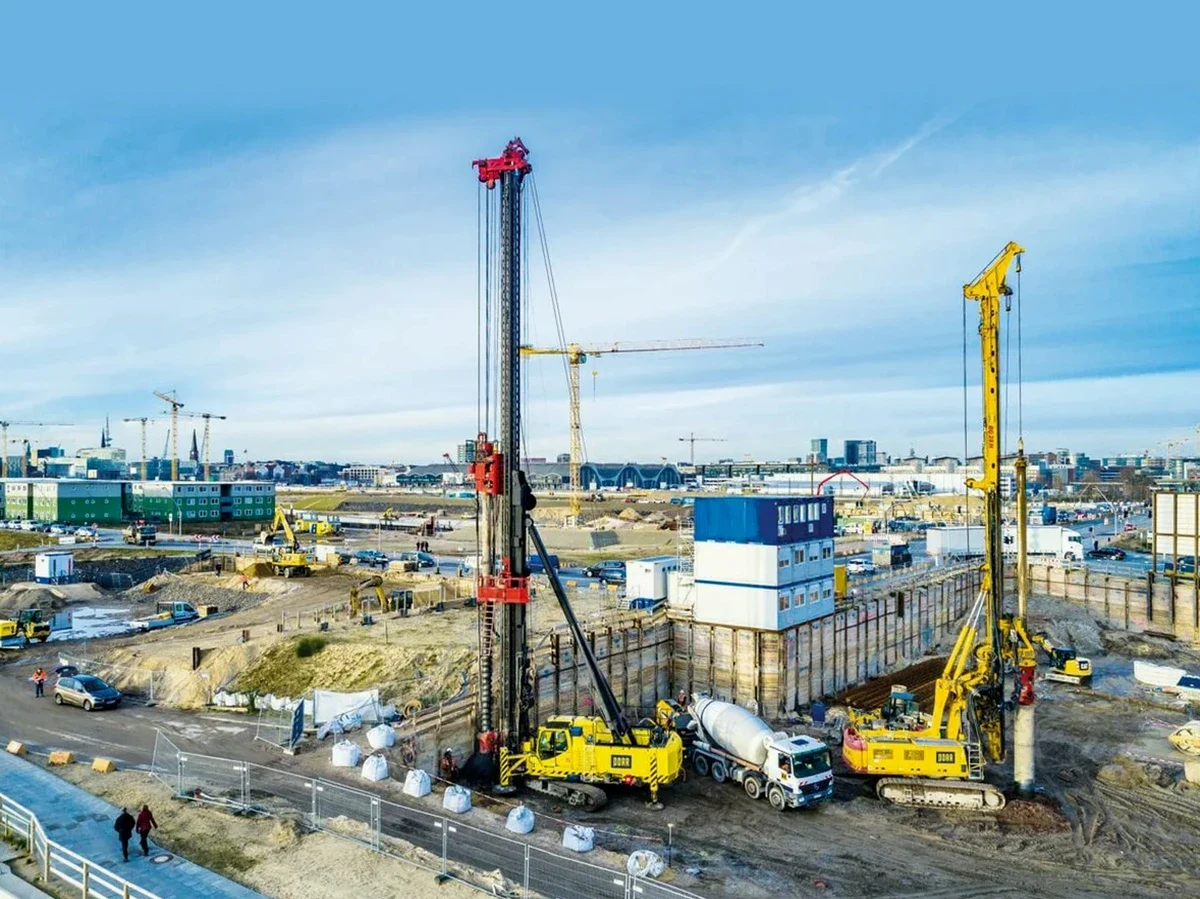
Typical technical challenges in Whitby
Whitby's expansion from a small harbour town into a GTA commuter hub means a lot of today's subdivisions are built on re-contoured farmland. The fill placed in the 1990s along the Taunton Road corridor is still settling, and we routinely measure negative skin friction downdrag loads that add 15 to 25 percent to the pile structural demand. Older neighbourhoods near the harbour have a different problem: undocumented timber piles under century homes, now surrounded by modern infill development where deep excavations for neighbouring basements have altered the groundwater flow. If the new pile design doesn't account for the reduced lateral confinement from adjacent excavation, the pile group can lean. We model both the geotechnical and structural limit states per CSA A23.3, but the real safeguard is local expertise — knowing which pockets of Whitby have artesian conditions in the shale fractures that can blow out a CFA column during construction.
Our services
A pile foundation design package for a Whitby project has to move beyond textbook formulas. Here's what we assemble for each site:
Axial capacity analysis with site-specific beta coefficients
We back-calculate the shaft resistance factor from in-situ SPT and CPT data, not from regional tables. For Queenston shale sockets, we use the Rowe and Armitage method with a reduction for weathered RQD.
Lateral load and group effect modelling
LPILE and GROUP analyses for wind bracing on tall residential structures. We input the actual strain-softening behaviour of the stiff clay till, which is different from the softer Toronto clays further west.
Pile driving analyser (PDA) test supervision and capacity verification
We monitor the initial drives on-site to confirm that the hammer energy is transferring effectively through the overburden into the shale, adjusting the driving criteria before production piles are installed.
Common questions
How deep do piles need to go in Whitby to reach competent bedrock?
North of Dundas Street the Queenston shale is often encountered between 2.5 and 5.0 metres below grade. South of the 401, the overburden thickens and competent shale may be 8 to 14 metres down. The critical variable isn't just depth — it's the rock quality designation (RQD) of the upper metre of bedrock. Weathered shale with an RQD below 25 percent can compress under load, so we typically specify a socket at least 1.5 metres into fresh shale with an RQD above 60 percent.
What is the cost range for a pile foundation design for a single-family home in Whitby?
For a typical single-family residential project, the geotechnical investigation plus the pile foundation design package falls between CA$2,480 and CA$8,490. The spread depends on the number of boreholes required, whether CPT profiling is needed for the upper soils, and the complexity of the structural loading. A straightforward two-pile interior column on shallow shale costs less than a full perimeter pile group on deep compressible silts near the lake.
Does Whitby require a pile load test for residential foundations?
The Ontario Building Code doesn't mandate a static load test for every residential pile, but many Whitby building officials now request either a PDA (Pile Driving Analyser) test during installation or a static test to 200 percent of the design load if the site is within a known area of variable fill. We recommend a PDA test on the first production pile as a minimum — it verifies the hammer performance and confirms that the pile toe is bearing on competent shale, not a boulder.
How do you handle frost heave on pile shafts in Whitby's climate?
The NBCC 2020 requires a frost penetration depth of at least 1.2 metres in this region. We design the upper portion of the pile with a bond-breaker detail — typically a sonotube sleeve or a bituminous coating — over the frost-susceptible zone so that heaving soil can't grab the shaft and lift the pile. For steel H-piles, we also specify a reinforced concrete cap that extends below frost depth to carry out mass resistance against uplift.