The first thing we do on a Whitby site is deploy the CPT rig to map the contact between the overlying glacial till and the underlying Georgian Bay Shale. In the Iroquois Beach area, south of Highway 401, a 20-tonne cone pushing through stiff silty clay tells us more in two hours than a week of conventional drilling. The friction ratio spikes right at the weathered shale interface, typically between 8 and 14 metres depth, which defines the bearing stratum for a cantilever wall footing. We run dissipation tests at that transition zone because pore pressure response controls drained versus undrained earth pressure coefficients in the design model. For taller walls above 4 metres, combining CPT data with a triaxial test on undisturbed Shelby tube samples gives us the effective stress parameters — c' and phi' — that govern long-term stability on these sloping lakeshore lots.
A Whitby retaining wall fails from the bottom up — the key is locking into intact shale where the passive wedge develops full resistance.
Technical details of the service in Whitby
Procedure video
Typical technical challenges in Whitby
The Halton Till that blankets most of Whitby is a dense, overconsolidated diamict with a nasty secret: it softens on a timescale of hours when exposed to air and water. We have measured slake durability indices below 60% on samples from the Lynde Creek watershed, meaning the excavation base can degrade between final trim and mudmat placement. That lost passive zone in front of the toe reduces sliding resistance by up to 40 percent. The Georgian Bay Shale below is mechanically stronger but brings its own problem: horizontal stress relief during excavation causes heave and bedding-plane separation. We monitor rebound with a precise level survey during bulk excavation and adjust the foundation drain design if groundwater flow concentrates along the opened shale laminations. In the Port Whitby area, where fill overlies organic silt from the ancient marsh, differential settlement at wall returns can crack the stem within the first freeze-thaw cycle. We address this with a continuous footing key cast into the natural till below the fill line.
Our services
Our Whitby retaining wall scope covers the full geotechnical chain from subsurface investigation through reinforcement detailing. Each phase feeds the next: the soil parameters from field testing drive the lateral earth pressure model, which determines the structural section and drainage system specification.
Site Investigation and Parameter Derivation
CPT soundings and selective Shelby tube sampling to establish the till-shale interface depth, effective strength envelope, and groundwater profile at the wall alignment.
Lateral Earth Pressure Analysis
Calculation of active, at-rest, and passive pressure distributions for cantilever, gravity, and mechanically stabilized earth configurations, including seismic increment per NBCC.
Reinforced Concrete Detailing
Stem and footing reinforcement schedules per CSA A23.3 with bar development lengths, shear friction at construction joints, and waterstop specification for below-grade joints.
Construction-Phase Monitoring
Heave survey during shale excavation, compaction testing of structural backfill, and pre-pour inspection of the bearing surface to confirm intact till or shale with no softening.
Common questions
What depth of shale embedment is needed for a cantilever wall in Whitby?
Minimum 1.5 metres of sound shale below the footing base, confirmed by CPT refusal and visual inspection. In weathered zones near the till contact, we extend the key to 2.0 metres and undercut any softened material.
How is frost protection handled for retaining walls in Whitby?
The footing base is set at 1.2 metres below finished grade, consistent with Ontario Building Code frost depth for Durham Region. We also specify air-entrained concrete with a maximum 0.45 water-cement ratio for the exposed stem to resist freeze-thaw scaling.
What is the typical cost range for a retaining wall design in Whitby?
Design fees for a residential retaining wall in Whitby typically range from CA$1,640 to CA$5,280, depending on wall height, access constraints for the CPT rig, and whether a slope stability assessment is triggered by proximity to a watercourse or property line.
Do you design segmental block walls or only cast-in-place concrete?
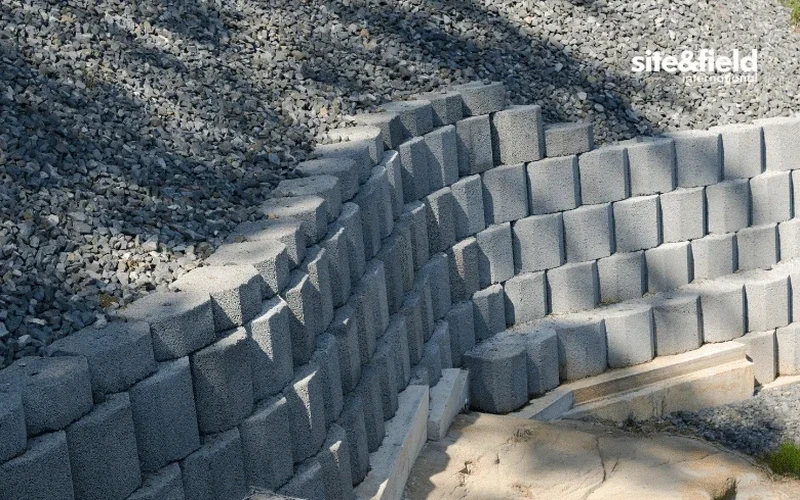
We design both. For segmental block walls we carry out the reinforced soil mass geometry, geogrid specifications, and global stability analysis. For cast-in-place walls we deliver the full structural drawing set with reinforcement schedules and drainage details.