The soil profile in Whitby shifts dramatically from the sandy deposits near Port Whitby to the dense clay till up in Brooklin — and that contrast directly affects compaction requirements on any construction site. A subdivision off Taunton Road sitting on glacial till doesn't behave the same way as a shoreline project on Lake Ontario's reworked sands. The sand cone method remains the most practical way to verify field density in these conditions, because it gives us a direct measurement of in-place density and moisture content without relying on indirect correlations. We run these tests daily across Durham Region, typically alongside a Proctor curve from grain size analysis to establish the target maximum dry density for the specific material on site. When Whitby's variable stratigraphy puts sand over clay or fill over native till, knowing the actual compaction percentage — not an estimate — is what keeps the building inspector satisfied and the foundation performing as designed.
A 2% compaction shortfall on a Whitby trench backfill can mean a $30,000 asphalt patch five years later — the sand cone tells you now, not later.
Technical details of the service in Whitby
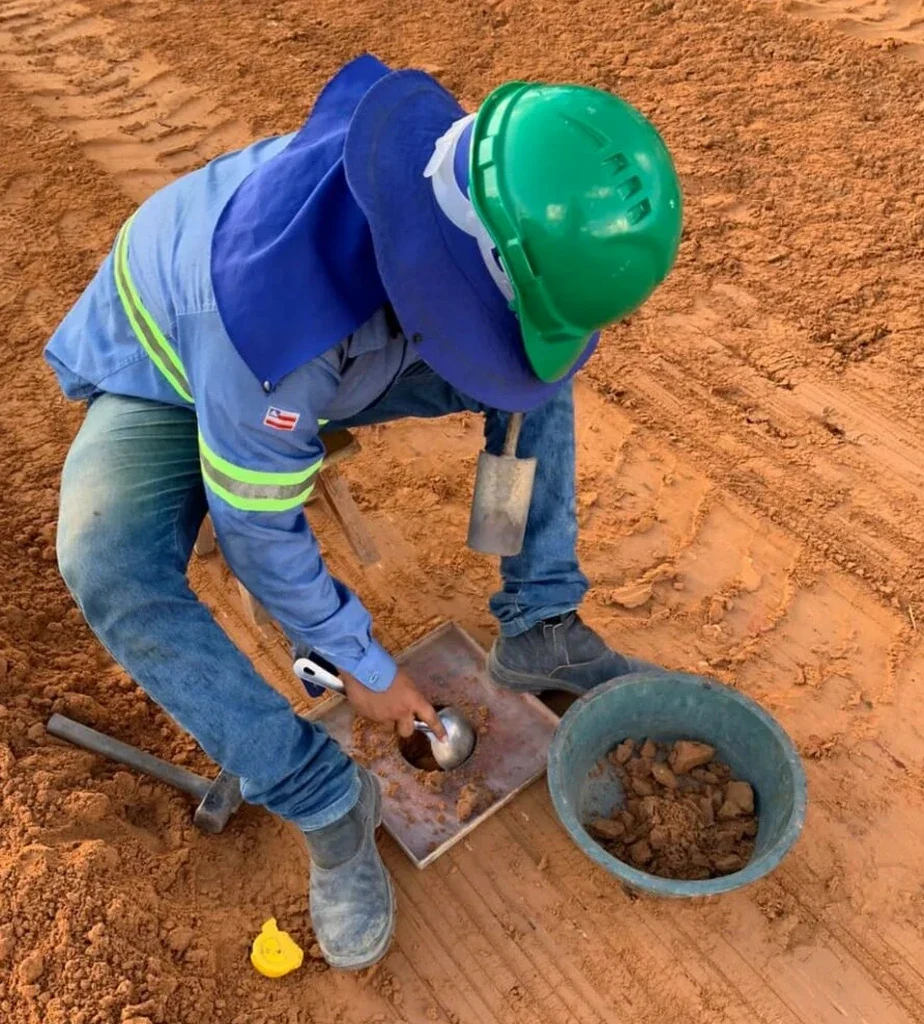
Typical technical challenges in Whitby
Whitby's position between Lake Ontario and the Oak Ridges Moraine creates two distinct soil moisture regimes that affect compaction work year-round. The lakeshore areas from Whitby Shores to Lynde Creek carry higher groundwater tables and fine sands that can pump under vibration if over-compacted or over-wetted — we see this regularly on waterfront infill projects. Meanwhile, the northern developments on moraine-derived silty tills can appear dry at the surface but hold perched water lenses that ruin compaction lifts if not caught during density testing. A sand cone test that includes a moisture content check catches both scenarios. In late spring, when frost leaves the ground and subgrade moisture spikes, passing a density spec becomes harder even with adequate compactive effort. Scheduling tests immediately after compaction — not the next day — is critical because Whitby's spring weather can re-saturate an exposed lift within hours, skewing results and delaying foundation approvals.
Our services
Our field density testing in Whitby covers every stage where compaction verification is required — from subgrade inspection to final lift approval. Each test includes a written report with density, moisture content, and percent compaction against the specified Proctor target.
Subgrade Density Testing
Sand cone tests on natural ground or proof-rolled subgrade prior to placing structural fill or pouring footings. We verify compaction at the bearing elevation across the entire footprint.
Utility Trench Backfill Verification
Compaction testing in lifts for water, sewer, and storm lines under Whitby roads. We test each lift as it's placed to meet the municipality's minimum density before paving.
Building Pad & Slab-on-Grade Control
Density checks on compacted fill beneath slabs and shallow foundations. We correlate field density results with Proctor curves so the engineer can sign off on the pad.
Compaction Troubleshooting
When a lift fails spec, we run moisture content and re-test after adjustment — helping the site superintendent dial in roller passes, moisture conditioning, and lift thickness.
Common questions
How much does a field density test using the sand cone method cost in Whitby?
A single sand cone density test typically runs between CA$130 and CA$210, depending on site access and whether the Proctor reference curve is already available. For multi-point projects — like a subdivision road or a commercial building pad — we price by the day or by the number of lifts tested, which brings the per-test cost down. Mobilization across Whitby (including Brooklin and the waterfront area) is included in our standard pricing.
How many sand cone tests do I need on my Whitby project?
The number depends on the spec. OPSS 501 generally calls for one test per lift per 500 m² of compacted area, or one per 30 linear metres of trench. For a typical single-family home pad in Brooklin, we usually recommend a minimum of four tests — one near each corner — on the final lift before the footing inspection. On larger commercial sites, we work with the geotechnical engineer's testing schedule to space tests at the frequency specified in the soils report.
Why use the sand cone method instead of a nuclear density gauge in Whitby?
The sand cone gives a direct volume measurement and isn't affected by the mineralogy or moisture variability common in Whitby's glacial tills and lake deposits. Nuclear gauges require radiation safety protocols, licensing, and can give skewed readings in high-organic or iron-rich soils — conditions we encounter in the Pringle Creek lowlands and along the lakeshore. Many Whitby municipal inspectors also prefer the sand cone for final trench compaction sign-off because the test hole provides a visible confirmation of the material at depth.