Many contractors in Whitby assume a 2:1 cut is safe without site-specific data. That assumption fails when you hit the glaciolacustrine silts underlying the Iroquois Plain. We see it too often: a subdivision excavation near the Lake Ontario shoreline begins to creep after a spring thaw, and the remediation costs triple the original earthworks budget. Our team runs slope stability analysis using Spencer and Morgenstern-Price methods calibrated to Whitby’s layered stratigraphy—not generic textbook profiles. The analysis quantifies the factor of safety against rotational and translational failure under both static and seismic loading, referencing the seismic hazard values from the 2020 NBCC for southern Ontario. Before finalizing your grading plan, a deep excavation monitoring program integrated with the stability model can carry out real-time validation of the design assumptions during construction.
A one-meter rise in the phreatic surface can reduce the factor of safety by 30% in the silty clays common across Whitby.
Technical details of the service in Whitby
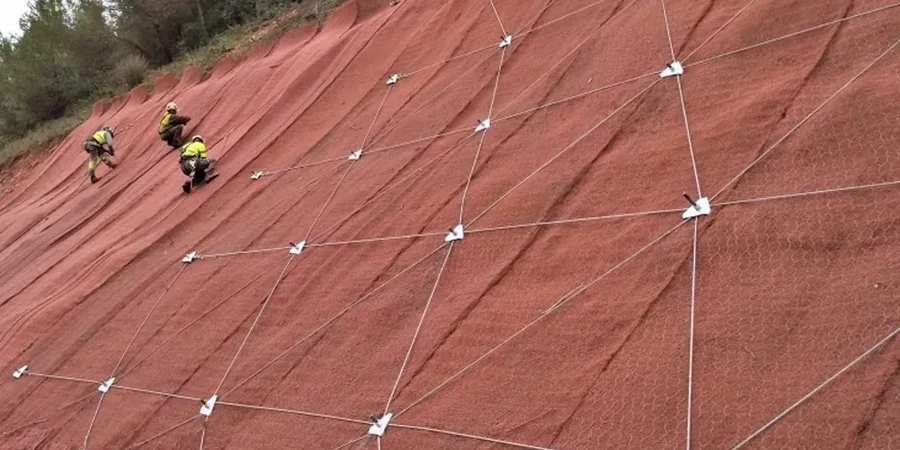
Typical technical challenges in Whitby
Whitby’s climate creates a specific risk profile for slope stability that differs from drier regions in Ontario. The freeze-thaw cycles from November through March open fissures in the near-surface clay crust, and the rapid snowmelt in early spring saturates these cracks before the underlying till has time to drain. This scenario triggered shallow planar failures along several creek valleys in the municipality over the past decade. Coastal bluffs along Lake Ontario face a different mechanism: wave undercutting at the toe removes passive resistance, reactivating deeper rotational slides. Our analysis explicitly models transient pore pressure response to precipitation records from the Whitby weather station and applies a tension crack depth based on the undrained shear strength of the upper weathered zone. We recommend a factor of safety no lower than 1.5 for permanent residential slopes and require a peer review of all models by a second senior engineer before the report is sealed.
Our services
We deliver a complete package that takes a Whitby project from initial site reconnaissance through to a sealed, construction-ready stability report. The two core service phases are designed to overlap so that field data directly feeds the analytical model without delay.
Site Investigation and Instrumentation
Sonic drilling through overburden to refusal, installation of standpipe and vibrating-wire piezometers for seasonal monitoring, sampling of undisturbed Shelby tubes in the glaciolacustrine unit, and downhole shear-wave velocity measurement for seismic site class determination.
Stability Modeling and Design Review
Two-dimensional limit equilibrium analysis using Roescience Slide2, finite element seepage modeling in SEEP/W, probabilistic back-analysis of existing landslides where applicable, and detailed cross-section drawings with recommended slope geometries, drainage measures, and reinforcement specifications.
Common questions
What is the cost of a slope stability analysis for a typical residential lot in Whitby?
A slope stability analysis for a standard residential property in Whitby typically falls between CA$1,850 and CA$5,220. The final cost depends on the slope height, the number of boreholes required, and whether installation of monitoring instruments like piezometers is needed.
Which analysis method is most appropriate for the Halton Till slopes in Whitby?
We apply the Morgenstern-Price method for slopes where the Halton Till overlies the Queenston Shale. This rigorous limit equilibrium method satisfies both force and moment equilibrium, making it suitable for the non-homogeneous, layered stratigraphy found across Whitby’s creek valleys.
How does the NBCC 2020 seismic hazard affect a slope stability analysis in Whitby?
The NBCC 2020 assigns a peak ground acceleration (PGA) of approximately 0.12-0.15g for the Whitby area on firm ground. We incorporate this as a pseudo-static horizontal coefficient in the limit equilibrium model, which typically reduces the static factor of safety by 10 to 20 percent for permanent slopes.
What groundwater conditions do you consider for a Whitby slope?
We model two critical scenarios: a long-term steady-state phreatic surface based on piezometer readings, and a transient wet-season condition where a perched water table develops in the upper weathered silt during spring snowmelt. The transient case often governs the design for shallow failure modes in Whitby.
Do you provide recommendations for slope remediation if the factor of safety is too low?
Yes, the report includes practical remediation options such as slope flattening, toe berm construction, installation of trench drains to lower the phreatic surface, or soil nailing with a reinforced shotcrete facing. We evaluate each option’s cost-effectiveness against the required gain in factor of safety.