We keep seeing the same costly mistake in Durham Region: teams treat the Halton Till like it's a uniform material, only to hit a pressurized sand lens at 12 meters that floods the heading. Whitby's subsurface isn't just "soft ground"—it's a glacially overconsolidated sequence where the Newmarket Till sits directly on fractured Queenston Shale, and the transition zone can be saturated, weathered, and mechanically unpredictable. That interface is where most tunnel drives stall. We run a full geotechnical breakdown for each reach, combining the CPT test to map the sand stringers within the till and the triaxial to get the effective stress parameters you actually need for a PLAXIS model. If you're planning a utility tunnel or a microtunnel bore under the 401, don't let the desktop study be the only thing between you and a blowout.
The interface between the Halton Till and the Queenston Shale is where Whitby tunnels fail—not in the soft clay, not in the rock, but in the transition.
Technical details of the service in Whitby
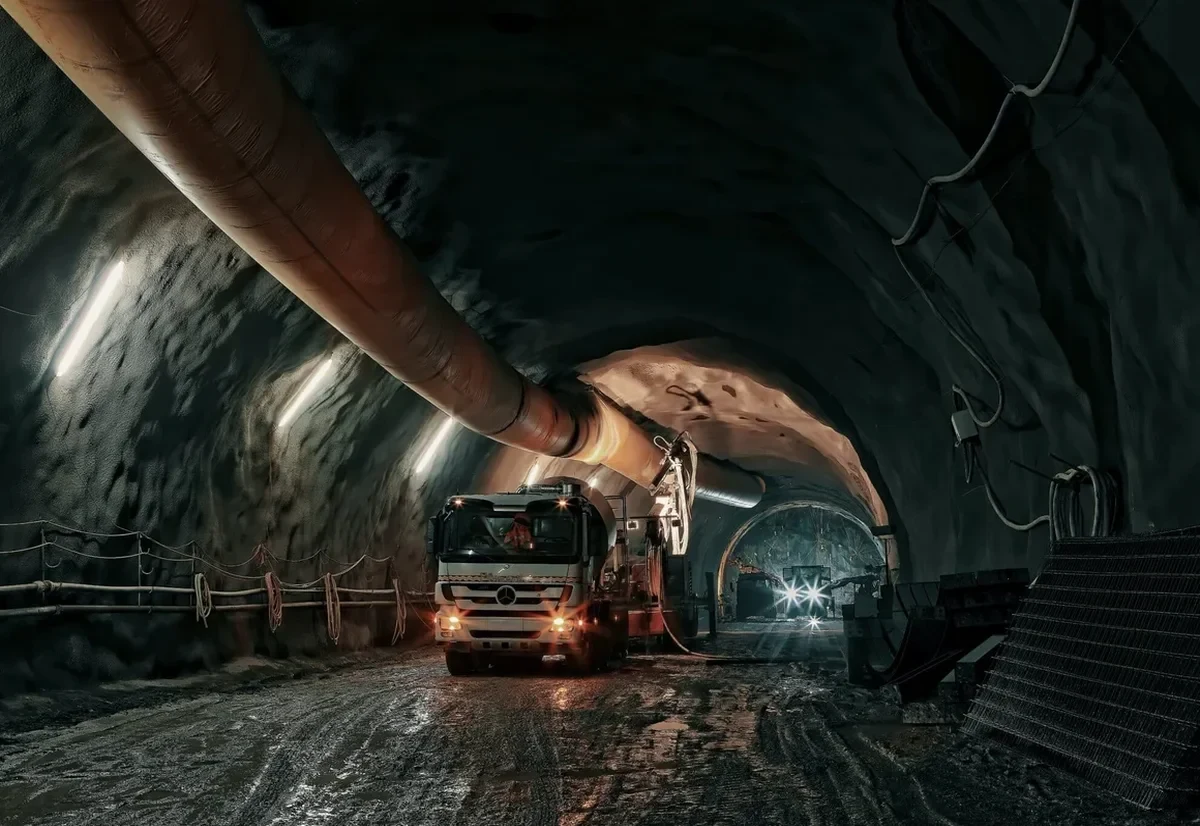
Typical technical challenges in Whitby
The 2015 Ontario Building Code, referenced through the NBCC, classifies much of the Whitby waterfront area as a high groundwater risk zone—and that's not just a paperwork issue. When you excavate below the Lake Iroquois water table, which sits at roughly 2 to 4 meters depth across most of the town, the hydraulic connection between the sand seams and the lake can sustain inflows that overwhelm a standard dewatering system. For a tunnel alignment along Victoria Street, where the cover is minimal and the Halton Till is thin over the shale, a blowout at the face can propagate to a surface sinkhole in less than an hour. We've seen this mechanism in similar settings across the Greater Toronto Area. Our risk assessments always include a back-analysis of the critical hydraulic gradient for each soil unit, and we specify the required filter criteria for any groundwater control measures. If the tunnel crosses the shale contact, we also screen for hydrogen sulfide and sulfate attack on concrete liners—the Queenston Shale is pyritic, and the oxidation products can degrade the shotcrete within the design life if the mix design isn't adjusted.
Our services
A tunnel through Whitby's glacial sequence demands more than a standard site investigation. We structure every program around the specific failure mechanisms that the local geology presents:
Tunnel Face Stability Analysis
We compute the required support pressure for each reach using limit equilibrium and finite element methods, incorporating the undrained shear strength profile from field vane and triaxial testing.
Groundwater Control Design
We design dewatering and grouting schemes based on packer test data and piezometric monitoring, targeting the discrete sand lenses that cause the majority of inflow problems in Whitby's till.
Settlement Trough Prediction
We model the three-dimensional settlement field using calibrated small-strain stiffness parameters, and we establish trigger levels for instrumentation arrays along the alignment.
Rock-Soil Transition Assessment
We characterize the weathered shale contact with core logging (RQD, fracture frequency, infill) and laboratory strength testing to define the geotechnical baseline for mixed-face tunneling.
Common questions
What are the typical face stability challenges when tunneling in Whitby's glacial deposits?
The main issue isn't the clay itself—it's the perched groundwater in sand and silt lenses within the Halton Till. When a tunnel face exposes one of these lenses, the seepage pressures can trigger a running ground condition that erodes the face rapidly. We quantify this by installing vibrating wire piezometers at multiple depths during the site investigation phase, measuring the hydraulic head in each discrete sand unit. For the Newmarket Till, the undrained shear strength typically ranges from 80 to 150 kPa, which is adequate for short unsupported spans, but the sensitivity of the overlying lacustrine silts means any remolding from a TBM or sequential excavation can drop the strength below 10 kPa. Our analysis always includes a sensitivity assessment and a groundwater control plan specific to the Whitby till stratigraphy.
How do you assess surface settlement risk for a tunnel under Whitby's residential areas?
We don't use a generic volume loss percentage—we back-calculate it from the actual stress-strain response of the Halton Formation soils at the tunnel depth. This means running consolidated-undrained triaxial tests at in-situ stress levels and measuring the small-strain stiffness with bender elements. For tunnels under existing subdivisions south of Rossland Road, where the cover is often less than 6 meters, we model the settlement trough using the Gaussian curve method and calibrate it against empirical data from the Port Whitby outfall project. The CSA A23.3 standard doesn't give you a settlement limit for buried utilities—we reference the NBCC and the Ontario Building Code for angular distortion criteria, and we set instrumentation triggers accordingly.
What's the cost range for a geotechnical investigation for a soft ground tunnel project in Whitby?
For a tunnel project in the Whitby area, the investigation scope drives the cost significantly. A targeted program with 3 to 4 boreholes, in-situ vane testing, piezometer installation, and a full lab suite (triaxial, oedometer, grain size, Atterberg limits) typically falls between CA$5,020 and CA$22,740, depending on depth, access constraints, and the number of specialized tests. A longer tunnel alignment crossing multiple geological units—say from the waterfront up to the 407 corridor—will require a more extensive campaign at the upper end of that range. Every proposal we prepare is site-specific; we don't do flat-rate lump sums without seeing the alignment first.