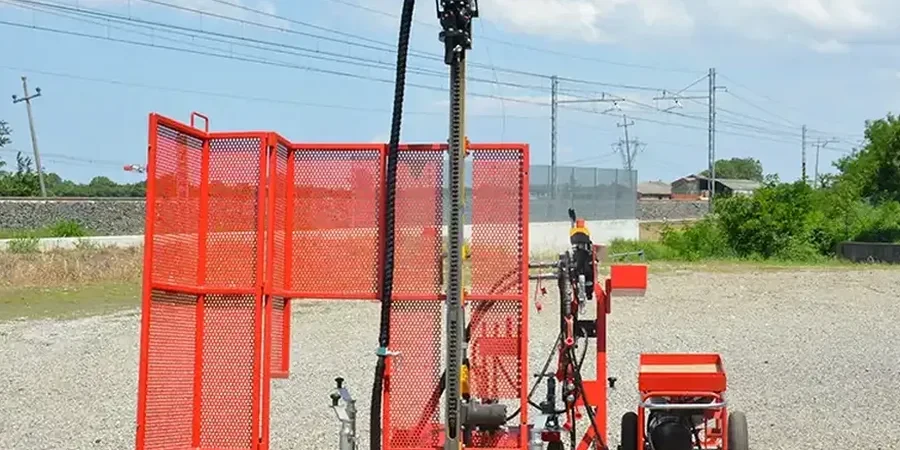
The CME-75 truck-mounted drill rig sets up on a glacial till site off Thickson Road, and within minutes the automatic hammer is lifting the 140-pound donut weight to its 30-inch drop height. In Whitby, where the subsurface shifts from stiff Halton Till to loose sands of the Lake Iroquois plain within a few hundred meters, the Standard Penetration Test remains the most practical tool for logging these transitions. We mobilize our drill crews across Durham Region with equipment that handles the dense boulder clays common near the waterfront and the softer deposits inland toward Brooklin. Each SPT blow count gets recorded at 6-inch intervals, producing N-values that feed directly into bearing capacity models and liquefaction assessments under the National Building Code of Canada. The combination of split-spoon sampling and in-situ resistance data gives engineers a continuous profile that no single parameter can replace, and in a town growing as fast as Whitby, getting that profile right on the first borehole saves weeks of redesign downstream.
N-values below 5 in saturated fine sands north of the 401 are a red flag for liquefaction that no amount of structural overdesign can safely ignore.
Technical details of the service in Whitby
Typical technical challenges in Whitby
The most costly mistake we see repeat across Whitby subdivisions is assuming that N-values from a neighboring lot apply to the next one without drilling it. Post-glacial Lake Iroquois deposits create abrupt lateral changes: one property sits on dense basal till with refusal at 9 meters, and the one two doors down encounters 6 meters of compressible organic silt that never showed up on the original geotechnical report. Builders who skip the SPT on the second lot end up with foundation settlements that crack partition walls within the first year of occupancy. Another recurring issue is neglecting energy correction: uncorrected N-values from older safety hammers without an Er measurement can overestimate strength by 30 to 40 percent, which translates directly into undersized footings. The NBCC 2015 requires site-specific investigations for a reason, and in a jurisdiction where the local conservation authority also reviews geotechnical submissions for slope hazard zones, incomplete SPT data stalls permits and adds carrying costs that far exceed the investigation budget.
Our services
Our Whitby SPT program includes the field investigation and the lab follow-up needed to turn blow counts into design parameters. Every split-spoon sample is logged by a geotechnical engineer before it leaves the site, and selected specimens go to our accredited soil mechanics laboratory for classification and strength testing.
SPT drilling and N-value profiling
Truck-mounted and limited-access drilling across Whitby, from Port Whitby shoreline properties to inland sites near the 412 corridor. Each borehole includes standardized SPT sampling at 1.5 m intervals, field logging of moisture, density, and color changes, groundwater monitoring, and a final log with corrected N60 values ready for foundation design.
Soil sampling and laboratory correlation
Split-spoon samples transported in sealed containers to our soil mechanics lab for particle size distribution, Atterberg limits, and moisture content determination. We correlate lab index properties with field N-values to refine bearing capacity estimates and to identify problem soils like sensitive clays or liquefiable silts before they dictate expensive mitigation.
Common questions
What does an SPT program in Whitby typically cost for a single-family residential lot?
For a standard residential lot in Whitby, an SPT investigation with one borehole to 8-10 meters depth, including drilling, sampling, log preparation, and basic lab classification, runs between CA$670 and CA$1,030. The spread depends on access conditions—truck-mounted rigs are efficient on open lots, but tighter sites in older neighborhoods like Port Whitby may need a smaller track-mounted unit that adds mobilization time.
How many boreholes does the Whitby building department require for a new house?
The Town of Whitby follows Ontario Building Code requirements, which typically call for a minimum of one borehole per single detached dwelling, though the building official may request additional investigation if the site is within a mapped floodplain, near a steep ravine (common along Lynde Creek or Pringle Creek corridors), or on known fill. For larger developments, borehole spacing is based on the geotechnical variability of the site, and we coordinate with the municipality early to avoid permit delays.
How deep does an SPT borehole need to go for a standard Whitby foundation?
Depth depends on the foundation type and the soil profile, but for a typical residential spread footing in Whitby we drill to at least the depth where the stress increase from the footing drops below 10 percent of the original overburden pressure—commonly 6 to 10 meters in the glacial till that underlies much of the town. If soft Lake Iroquois silts or organic deposits are encountered, we extend the borehole until we reach a competent bearing stratum with N-values consistently above 15, which in some areas south of Dundas Street can push the depth to 12 meters or more. More info.